
HaShem's Labour Union
The Two Shabbats of Parshat Vaetchanan

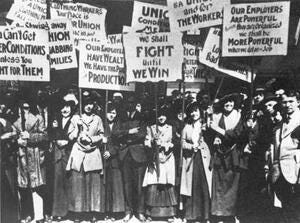
One of my favourite little sayings about Judaism is “halakha1 is a team project.” I want to talk for a moment about the single best example of that in our tradition: Shabbat.
In Parshat Vaetchanan, Moshe recounts the ten commandments to the Israelites. The language instructing us to keep Shabbat is similar, but ever-so-slightly different from the version we read in Parshat Yitro, when the Israelites first receive them.

This text closely tracks the version from Yitro, which is familiar to many as the second paragraph of Shabbat morning kiddush. There’s a strong similarity until the final phrase. The line “so that your male and female slave may rest2” is found in the second version alone.
This single line is key to making sense of the mitzvah of Shabbat. The whole point of Shabbat, the text seems to claim, is not for the rest of the person who is free, economically secure, and in control of their own time. The very essence of Shabbat is to safeguard the rights of the overworked and the enslaved.
This is a serious injunction, one with the power to forcefully shape Jewish economic life. Some commentators read this text as applying to the Eved Ivri, a Jewish person forced into debt slavery. The Emek Davar interprets this verse as a reminder that we are responsible for the halakhic observance of other Jews. God wants all Jewish people to keep Shabbat, so anyone who forces another Jew to work on Shabbat is breaking Jewish law. The point of Shabbat, according to this logic, is to make a day when all Jewish people, no matter their economic circumstances, are able to rest.
In my experience, this can be a very helpful way to think about melacha, the specific types of work that are prohibited on Shabbat, from planting seeds to kneading dough to using electricity. Many people, myself included, find gardening and painting with watercolors to be relaxing activities, which we love to do over the weekend. But by refusing to paint or pull weeds on Shabbat, we’re contributing to a long tradition that allows an underpaid contractor or an agricultural worker to say to their boss “I’m Jewish, and Jews don’t do this on Shabbat.”
The commandment to refrain from work turns the Jewish people into a labour union. We refuse to cross picket lines. We don’t work on Shabbat.
There’s a second way that we can understand the mitzvah of Shabbat as a team project. Unlike the Emek Davar and other commentators who read this commandment as applying to Jews, there are a number of rabbis, such as Rashi, who claim that the phrase “so that your male and female slave may rest” is talking explicitly about non-Jews. Shabbat, then, is about protecting the universal right to rest which is shared by all of humanity.
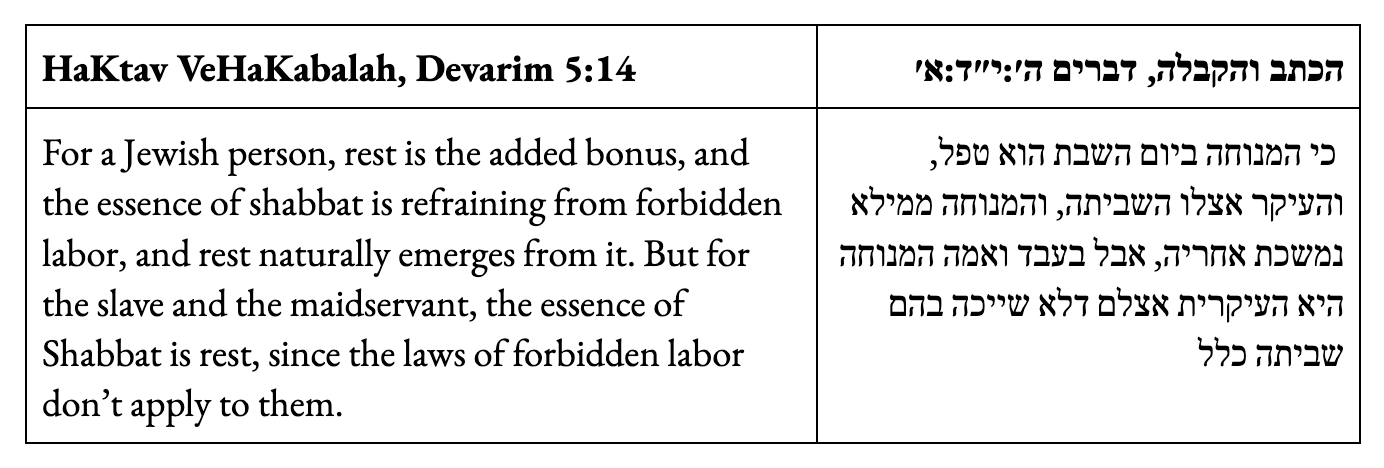
Rabbi Yaakov Tzvi Mecklenburg, in his work HaKtav VeHaKabalah, explains that, for Jews, the essence of Shabbat is refraining from doing forbidden work, which, ultimately, allows us to rest. Non-Jews, however, who don’t share our specific rules about Shabbat, still can -- and ought to -- have a day of resting from their labor.
Reading the commandment to keep Shabbat as requiring us to protect the rest of every person-- and particularly those who are oppressed -- has profound consequences. Sure, I turn my phone off before Shabbat. I eat luke-warm food that’s been warmed up on a hot-plate. But can I ever really say that I’m “keeping” Shabbat if I wear clothes made by workers who work 14 hour days, seven days a week? Can someone at an five-star kosher resort really say that they’re keeping Shabbat if Saturday is the hardest day of the week for the hospitality workers who are paid poverty wages? In a globalised, interconnected world, it is nearly impossible to individually opt-out of every system that mistreats workers. But individual perfection isn’t the point. This is a team project.
The Talmud teaches that if every Jew were to observe Shabbat twice, Moshiach would immediately come. Perhaps the two ways to read this commandment can teach us about “two Shabbats” that we must all observe. First, we must hold fast to Shabbat as our unique Jewish heritage, which has protected our people from exploitation for thousands of years. And second, we must build a world in which no person is denied their sacred right to rest.
May we see that day come speedily in our days. Shabbat Shalom.
Jewish Law
For a brief overview of slavery in the Torah and in Jewish tradition, see this article. I also highly suggest checking out the work of my friend Erica Riddick, whose work on the Bilha and Zilpa project explores questions of slavery, human hierarchies, and ethics.