
The In-Between
Yom Kippur 5786

Gmar tov. I’m currently on parental leave after welcoming my first baby earlier this year. I haven't published much Torah recently, but I wanted to share this drasha, which I’ll be giving during Yom Kippur Mussaf. I’m publishing it here before YK so those outside of London can read it before chag. For members of my shul (hi!) this post is the very definition of a spoiler. Thanks for understanding and gmar chatimah tovah!
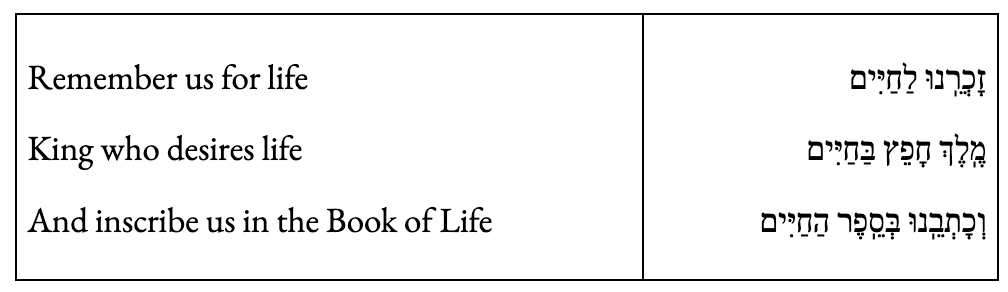
Throughout the Yamim Noraim, we pray to be written in the Sefer Chayyim, the Book of Life. The Rabbis understand Rosh HaShanah and Yom Kippur as days when HaShem convenes the heavenly court, the Beit Din Shel Ma’ala, and inspects our actions over the past year.
Take, for instance, the words we say in every Amidah:
The haunting words of Unetaneh Tokef sharpen this image:
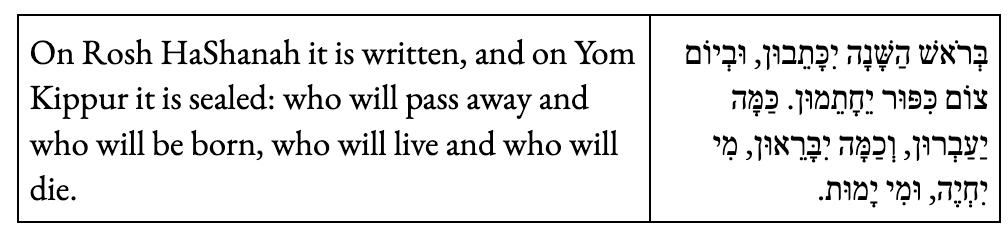
The most common interpretation of the language around “writing” and “sealing” is that there are two divine books: one Book of Life and one Book of Death, or a Book of Good and a Book of Evil.
Yet, there’s a voice in the Talmud that describes not two books, but three:
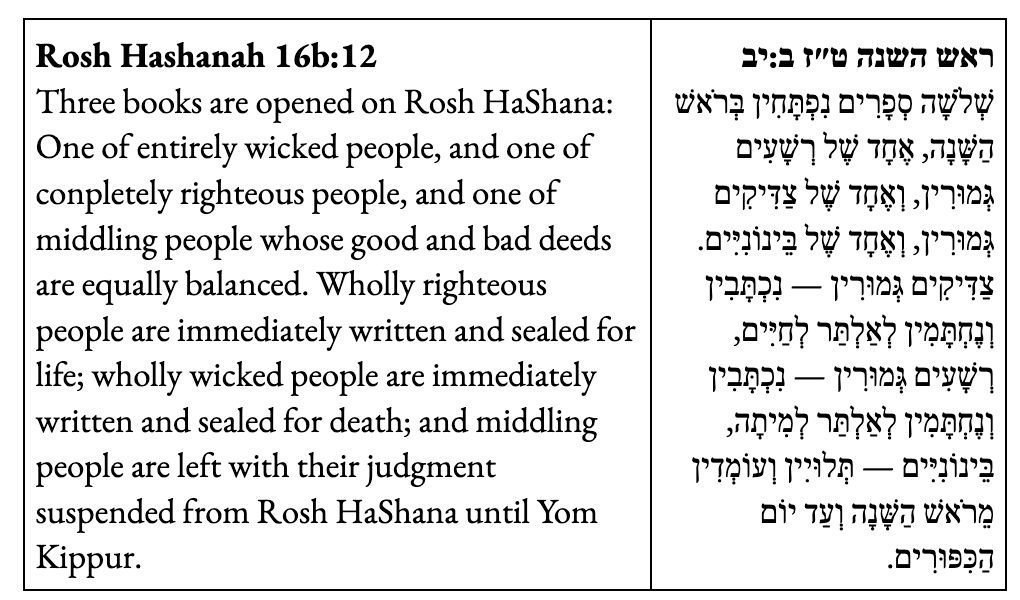
Unlike the binary that we see in Unetaneh Tokef —who will live and who will die— the rabbis here introduce a third, liminal category: the beinoni. The word beinoni comes from “bein,” meaning “between.” It means in-between, average, or middling.
There’s a famous story in the Gemara about self-identifying as a “beinoni.” The rabbis are sitting in the Beit Midrash, discussing the Evil Inclination, the Yetzer Hara, when Rava, one of the greatest scholars in Jewish history, turns to his colleagues and announces, “beinoni ana.” I’m a beinoni. His study partner, Abaye, doesn’t buy it. “If you, Rava, are a beinoni, you haven’t left any room for the rest of the world.” In other words, if someone as righteous as Rava is a beinoni, the rest of us must surely be r’shaim.
The simplest way interpretation of this story is that Rava believes that one can only be considered a tzaddik if they have a perfect track record, free from even a single misdeed or shortcoming. Rava is simply saying, “I’m a flawed human being, not a saint.”
Perhaps, however, Rava isn’t making an ontological assessment of his exact tally of mitzvot. Maybe he’s suggesting that no matter how much tzedakah a person gives or how much Torah they learn, they should see themself as a beinoni, a regular person capable of both good and evil.
This approach is consistent with advice given elsewhere in the Gemara:

In other words, we should all see ourselves as standing on the point of a needle between right and wrong, believing that every action we take has the power to tip the scale.
As we pray together this Yom Kippur, I want to flesh out three points about what it means to view ourselves with this “beinoni” mindset; to see ourselves in the in-between, as normal, imperfect people.
The first lesson we should learn about the beinoni is the danger of seeing ourselves as fundamentally bad, wicked people— as r’shaim.
The Alter Rebbe, the first leader of the Chabad chassidim, wrote extensively about the role of the beinoni in his seminal work, the Tanya. In fact, he views this concept as so critical to his thesis that the opening section of the Tanya is called Sefer shel Beinonim, the book of the beinoni. In it, the Alter Rebbe warns us never to label ourselves as a rasha.
He writes: “If a person is wicked in his own eyes, he will feel embittered and depressed, and he will be unable to serve G-d with joyful and a glad heart.”
While it might seem that admitting to being a rasha is a step towards accountability, it can actually keep us stuck in a place of hopelessness and shame. It’s saying, “I can’t be any other way.”
Seeing ourselves as beinonim isn’t a sort of post-modern moral relativism, in which there is no “moral” and “immoral” action. The very premise of Jewish law is that we are commanded to follow a rigorous standard of behaviour. We can— and should— take stock of the ways that we’ve missed the mark. Yet, even when we’ve messed up, we should be careful not to conflate our actions with essential qualities of our nature.
If a person takes stock and notices all the times they have flown into a rage, or lashed out at their friends and family, they might be tempted to think, “That’s who I am, an inherently angry person”. The Alter Rebbe’s approach is instead to say, “I’m just a person. What can I do to change this pattern?”
To see ourselves as fundamentally bad or unfixable is to give up on the possibility of teshuva.
The second lesson is that we should be wary of considering ourselves tzaddikim, or completely righteous people.
The rabbis in Masechet Niddah offer a warning:
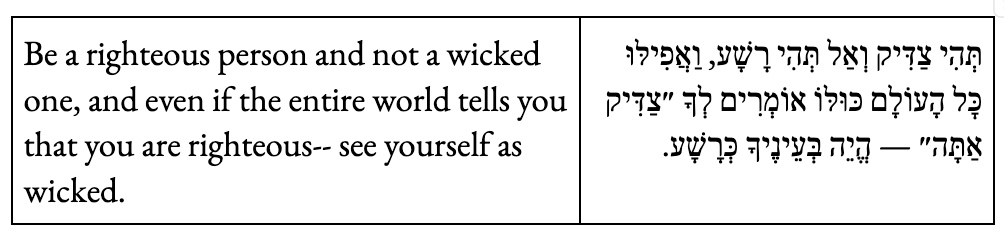
In other words, even if you have compelling evidence that you’re one of the good guys— you’ve got an OBE or Nobel Peace Prize— there’s danger in adopting the fixed identity of a tzaddik.
I remember, as a teenager, having a conversation about school shootings with my dad, who remarked that the worst human behaviour is often done by hurt people who feel that they are “restoring justice.” Again and again, the story emerges of a young person who has been bullied or humiliated for months, until they turn their pain outward in a burst of violence. When someone is convinced that they are righting a wrong, that they are a tzaddik who is simply fighting back, it can become easy to justify even the cruelest behaviour.
When any of us looks back on times that we’ve spoken harshly to a loved one this year, we might ask ourselves how often, in the moment, we’ve justified our bad behaviour: I’m just defending myself. I’m just responding to the way they’ve done me wrong. When we get stuck in the unshakeable conviction that we’re a tzaddik, we may, ironically, end up acting like our worst selves.
The third lesson is that we must resist the temptation to label entire groups of people as tzaddikim or r’shaim.
The Rambam, in Hilchot Teshuva, points out that the categories of tzaddik, rasha, and beinoni don’t just apply to individuals, but to nations and even to the world as a whole. It follows that, just as the Rabbis encourage us individually to see ourselves as beinonim, we should aim to do the same on a national, and even global scale.
In our tradition, there’s a powerful voice urging us to be an or la-goyim, a light among the nations— for the Jewish people to be a nation of tzaddikim. That clarion call is one of the things many of us value most deeply about our tradition.
Yet, we should notice when our focus on morality changes from an aspiration to a sense of fixed identity, when we start telling ourselves not that we’re striving to be a light among the nations, but that we are a light among the nations. According to that line of thinking, Jewish people are distinguished from the rest of humanity by our particular concern with ethics. We are the immutable arbiters of right and wrong. The Jewish people are the good guys, up against a world full of r’shaim.
Seeing ourselves as a nation of tzaddikim is dangerous because it obscures the fact that Jewish tradition urges us to continually learn, to reflect on our actions, and to make teshuva. It’s a way of bypassing introspection and shirking accountability. Tzaddikim are already written in the Book of Life. Case closed. Yom Kippur is cancelled and we can all go home.
If, however, we see ourselves as beinonim, as flawed people, capable of good and bad, and, critically, if we see others the same way, then we’re on fertile ground.
Let’s imagine two Jewish people who are equally committed to resisting antisemitic hatred. One of them sees the Jewish people with the fixed identity of tzaddikim and views the rest of the world as hostile. As a result, they might react fiercely when confronted with prejudice against Jews— and rightly so— yet look the other way when their fellow Jews traffic in cheap stereotypes and racism. The other Jewish person, meanwhile, sees our people as beinonim, capable of both good and evil. This Jew also fights fiercely for Jewish safety— and they work just as hard to defend the dignity of their non-Jewish neighbours, recognising that we, too, are capable of causing harm.
To see ourselves as beinonim is to believe that we can— and must— consistently reflect on our actions, changing course when we need to. If we believe that our fellow humans (or at least most of them) are beinonim, we believe that they too are capable of taking responsibility when they miss the mark.
A world of beinonim is a world in which teshuva is possible. It is a world that is capable of repair.
In Masechet Rosh HaShanah, during a discussion about the ten days of teshuva, the rabbis suggest that gezer din shel tzibbur aino nechtam— the fate of the community, of all of us when we pray together, is never sealed. While an individual may be permanently sealed in the Book of Tzaddikim or the Book of R’shaim, the Book of Life or the Book of Death, the rabbis suggest that the Divine books always remain open for our people as a whole.
This is a core theological principle behind our prayers during the Yamim Noraim— that all of us have the capacity for both good and evil, that we have choices, that teshuva is always possible. We are standing, collectively, at the feet of the Holy One, and the book is still open.
May all of us have a meaningful Yom Kippur, and may all of us be written in the Book of Life.